
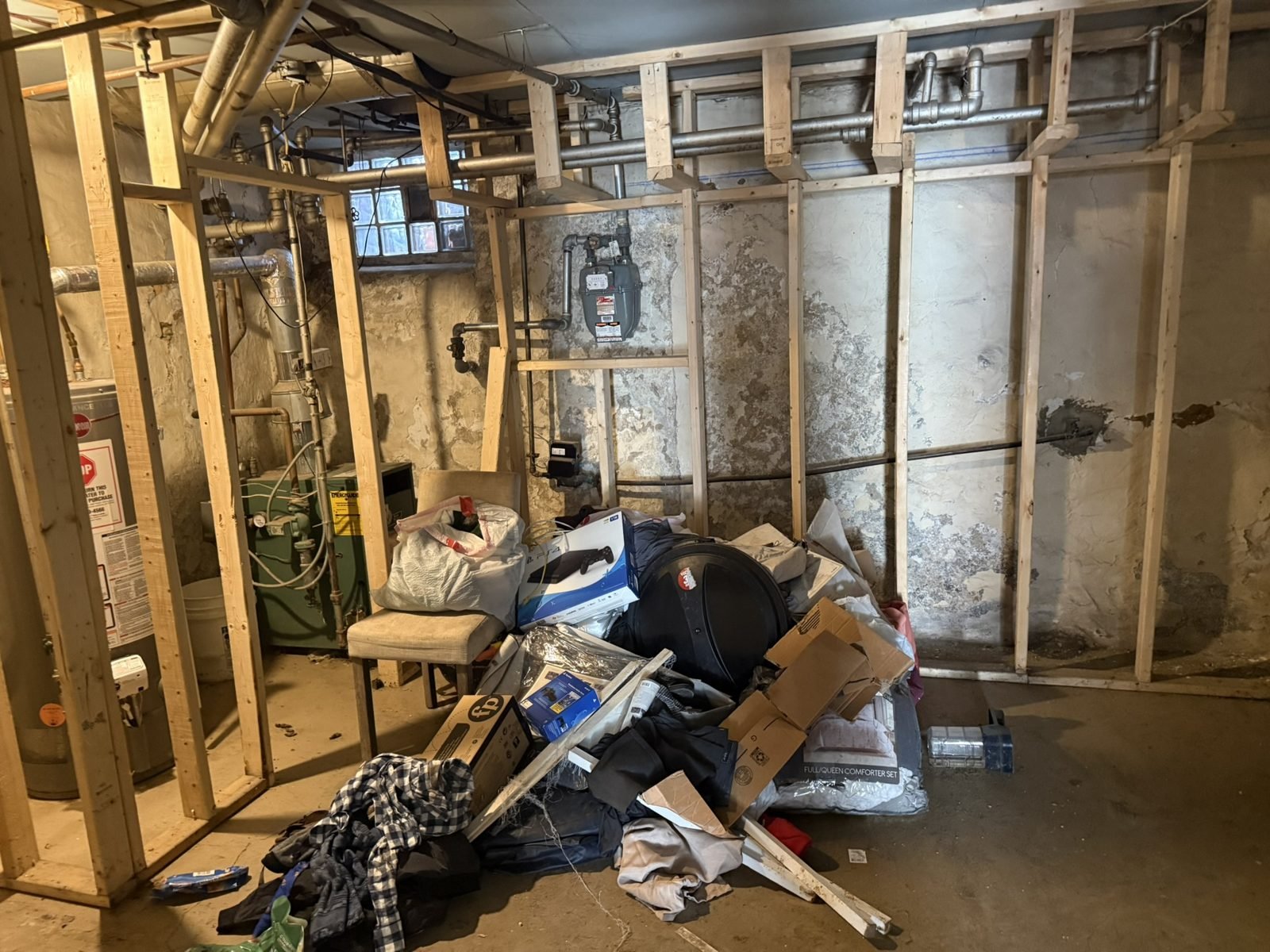
Will Parging Trap Moisture in Your Old Basement Walls?
Not when it's done right.
Short answer: Not when it's done right. A parge coat with lime in the mix, finished with a breathable water-blocking paint, still lets a stone basement wall dry. It doesn't seal the wall the way plastic sheeting, oil paint or vinyl does. What traps moisture is outside water that never gets handled, and hard coatings that don't breathe put over damp walls.
Book your free estimate, with a written price within 24 hours. Call 215-821-9779.
A homeowner getting ready to redo their basement asked us: "I think our walls are rubble stone. Would the new cement walls trap moisture behind them?"
It's a fair question. Old stone foundations do need to dry, and the wrong coating can cause real trouble. But a parge coat done the right way doesn't lock water inside the wall.
We're Dependable Concrete LLC, a family-owned concrete contractor in Philadelphia since 1984. Here's what really traps moisture, and how we parge so the wall keeps drying.
Why old stone basements need to dry
Old Philadelphia foundations were laid up with lime mortar. Over many years, that mortar slowly turns back to sand.
These foundations were rarely damp-proofed when they were built. Natural Resources Canada notes that they have a lot of mortar, which can soak up water from the soil around them. To stay healthy, the wall has to let that moisture move out through the mortar and the face of the stone.
That's why National Park Service guidance on old mortar warns against new material that's "excessively strong or vapor impermeable." So the worry behind the question makes sense. The real answer depends on what goes on the wall. If yours is already crumbling, our page on foundation wall repair in Philadelphia covers what we look for.

What really traps moisture in a basement wall
Moisture gets stuck when something stops the wall from drying. These are the usual causes:
- Hard, waterproof coatings over damp walls. The National Park Service warns that sealing a damp wall from the inside with a hard, waterproof coating can push moisture higher up the wall. The problem is a coating that won't let the wall dry, put over a wall that's already damp.
- Plastic sheeting. Plastic is a true vapor barrier. Building Science Corporation says barriers like this on the inside stop a wall from drying inward, which is "a problem in any below grade space."
- Oil paint. In lab tests, oil paint turned a breathable cement and lime plaster into a vapor barrier.
- Vinyl wall coverings and low-perm paints. The EPA says to avoid them when a wall needs to dry to the inside.
- Studs and drywall against the stone. We finish the original wall with cement, so there are no studs or drywall sheets to trap moisture.
The worry about parging comes from the same place. Straight cement and sand is fairly tight. Lab tests show a thick coat of it can act like a vapor barrier. That's why the mix matters so much.
Why our parge coat lets the wall dry
Lime makes the difference. Our parge mix contains lime, which lab research shows lets a cement coat pass far more water vapor. In those tests, adding even a small amount of lime opened up cement plaster a lot.
Our mix is sand, mortar cement that contains lime, and fiberglass for strength. Mortar cement is a factory-blended cement made for laying and coating stone and block. The standard it's made under allows lime as an ingredient.
It's a thin skin. A parge coat is a thin skin over the wall, not a thick shell. Thicker layers pass less vapor, so a thin coat lets more through than a heavy one would.
It protects the old mortar. For rubble foundations, Natural Resources Canada advises covering the inside wall "with cement-based parging to smooth the surface and to protect the existing mortar." It adds that the right parging "will also act as a sacrificial surface material."
The finish coat: a breathable water-blocking paint
After the parging cures, we finish with two coats of Sherwin-Williams Loxon Water Blocking Primer-Finish in white. Here's what the maker's data sheet says about it:
- It's made to stop water seeping through concrete and block walls.
- It's rated for inside walls below ground level.
- It still lets water vapor pass. Sherwin-Williams lists it at 35.43 perms, well above the 10-perm line building scientists use for "vapor permeable."
That 35.43 number is the paint's own rating from Sherwin-Williams, not a test of a whole wall. The paint goes on a bare surface after the cement has cured.
That's the difference between a finish that blocks water but lets the wall breathe, and plastic, oil paint or vinyl, which don't.

Before any coating: outside water and wet walls
Most basement moisture starts outside. Rain and snowmelt soak the soil. Gutters clog, downspouts dump water right at the wall, and the ground can slope toward the house. Leaking pipes and gaps where pipes pass through the wall let water in too.
No coating fixes that by itself, so get the outside water handled first:
- The ground should fall about 6 inches over the first 10 feet away from the house. That's the building code's standard.
- Downspouts should carry water more than 5 feet from the foundation.
- Leaking gutters and pipes should be repaired.
A wall that's actively wet needs the water source fixed and time to dry before anything goes on it. Even the paint maker says not to paint wet surfaces.
Not sure if water is coming through the wall or just collecting on it? Try the foil test in our post on a wet basement in winter. The National Park Service describes the same test. Parging is just one part of basement waterproofing in Philadelphia.
How we parge a rubble stone foundation
- We walk the basement, tap the wall for hollow spots and look for where water is coming in.
- We knock off loose, failing coating and crumbled material, fill holes and gaps, and seal around pipes.
- We wash the wall and put on a bonding coat.
- We put on our fiber-reinforced mix with lime, a scratch coat first and then a finish coat smoothed with a sponge.
- Once it cures, two coats of white Loxon Water Blocking go on.
You can see the full service on our basement wall parging in Philadelphia page.

White powder on a parged wall: what it means
Sometimes a white, chalky powder shows up on a parged wall. That's efflorescence, the salt left behind where moisture dries out of a wall.
It tells you two things. The wall is drying, which is what you want. And water is still getting in from somewhere, so it's worth checking gutters, downspouts and grading. Our post on efflorescence on basement walls goes deeper.
What a good contractor gets right
- Finds the water source first and makes sure it gets fixed.
- Strips loose material down to a sound wall and fills the gaps.
- Uses a mix with lime, not straight cement and sand.
- Lets the wall dry and the parge cure before painting.
- Finishes with a breathable water-blocking paint, not oil paint, vinyl or plastic.

FAQs
Will cement parging trap moisture in a rubble stone foundation?
Not when it's done right. Our parge mix contains lime, and we finish with a breathable water-blocking paint, so moisture can still dry out of the wall. The trouble comes from outside water that isn't handled and from coatings that don't breathe, like oil paint, plastic or vinyl.
Is a parge coat breathable?
Yes, it lets water vapor through, and the mix makes a big difference. Lab tests show lime helps a cement coat pass far more vapor than straight cement and sand, and our mix contains lime.
Why use a cement-based parge instead of pure lime?
A cement-based parge smooths the wall and protects the old mortar underneath. Natural Resources Canada recommends cement-based parging on the inside of rubble foundations, and the lime in our mix helps it pass moisture.
What paint goes on a parged basement wall?
We use Sherwin-Williams Loxon Water Blocking Primer-Finish. It's made to stop water seeping through concrete and block walls, it's rated for inside walls below ground, and Sherwin-Williams rates it as letting water vapor pass. Skip oil-based paint, vinyl and plastic on these walls.
Why is there white powder on my parged wall?
That's efflorescence, salt left behind as moisture dries out through the wall. It means the wall is drying, and it's also a sign to check your gutters, downspouts and grading.
Should I fix gutters and grading before parging?
Yes. The ground should slope away from the house about 6 inches over the first 10 feet, and downspouts should carry water more than 5 feet out. A wall that's actively wet needs to dry before it's coated.
Ready for a Written Estimate?
Book your free estimate, with a written price within 24 hours. Call 215-821-9779.
Family-owned and serving Philadelphia since 1984.
Sources
- Natural Resources Canada, Keeping the Heat In, Section 6
- National Park Service, guidance on old mortar
- National Park Service, Holding the Line: Controlling Unwanted Moisture in Historic Buildings
- Building Science Corporation, Understanding Vapor Barriers
- John Straube, Moisture Properties of Plaster and Stucco for Strawbale Buildings (2003)
- US EPA, Moisture Control Guidance for Building Design, Construction and Maintenance
- Sherwin-Williams, Loxon Water Blocking Primer-Finish data sheet
- International Residential Code, Section R401.3
- US DOE Building Science Education, Foundation Drain, Gutters, Downspouts
- University of Alaska Fairbanks Cooperative Extension, Permeability of Common Building Materials
Book Your Free Estimate Online
Ready to get started? Book your free estimate, with a written price within 24 hours. Our crew is courteous and professional from the first visit to the final cleanup. Tell us what you need, and we'll come out, take a look and walk you through the work in plain language.
Your written estimate within 24 hours of our visit. After we look at the job, you get a written, priced quote within 24 hours of the visit.
Book your free estimate or call 215-821-9779. We will return your call.
Rather talk? Call 215-821-9779